Who Is at Fault When a Car Hits a Pedestrian in Iowa
When a car hits a pedestrian, people often reach a conclusion before anyone has investigated. Some assume the driver must be at fault. Others hear that the pedestrian was outside a crosswalk and assume there is no case.
Neither assumption answers the questions that matter: Where was the pedestrian? Who had the right-of-way? What could each person see? And was there a reasonable opportunity to avoid the collision?
Those questions require evidence. They also require reading Iowa’s pedestrian laws together.
Start with the location of the crossing
Iowa Code section 321.327, titled “Pedestrians’ and bicyclists’ right-of-way,” requires a driver to yield to a pedestrian or bicyclist crossing within a marked crosswalk or an unmarked crosswalk at an intersection when traffic-control signals are absent or not operating, subject to the chapter’s other provisions. The driver must slow or stop when necessary to yield.
The word unmarked matters. White stripes are not the only way a crosswalk exists. Iowa’s definition includes the portion of a roadway ordinarily within the extension or connection of sidewalk boundaries at an intersection. Before accepting that someone was “outside the crosswalk,” examine the intersection and the sidewalk layout. See Iowa Code section 321.1(16).
Iowa Code section 321.328 addresses “Crossing at other than crosswalk.” A pedestrian crossing outside a marked crosswalk or an unmarked crosswalk at an intersection generally must yield to vehicles on the roadway. The section also addresses pedestrian tunnels, overhead crossings, and crossings where signals operate away from an intersection. Local ordinances may matter as well.
Crossing location is therefore an important starting point. It does not finish the investigation.
Drivers must use care outside crosswalks
Section 321.329 expressly preserves a driver’s duty to exercise due care to avoid hitting a pedestrian, notwithstanding section 321.328. It also requires a horn warning when necessary and due care upon observing a child or a confused or incapacitated person on the roadway.
That means “the pedestrian should have yielded” and “the driver could have avoided the collision” can both be relevant to the same case.
A driver does not automatically escape responsibility because the pedestrian crossed midblock. Nor does a pedestrian automatically establish fault merely by being struck. The investigation must examine the conduct of both people and whether that conduct contributed to the collision.
The facts that matter most
Where and when did the pedestrian enter the roadway
Identify the crossing location, direction of travel, lane of impact, and how long the pedestrian was in the roadway. Did the person emerge from behind a parked vehicle? Had the person already crossed several lanes? Was the driver turning, backing, or traveling straight?
The point where the pedestrian landed is not necessarily the point of impact. Video, debris, vehicle damage, measurements, and witness accounts can help establish the sequence.
What did the signals show
At a signal-controlled crossing, the timing matters. A pedestrian who began crossing with a WALK signal presents different facts from someone who started after the flashing hand appeared.
Under section 321.257, a WALK signal gives pedestrians permission to cross and requires drivers to yield. A steady or flashing hand prohibits starting the crossing, while pedestrians already crossing are directed to proceed to a safety zone. A green light does not give a turning driver unrestricted permission to drive through pedestrians lawfully in the intersection.
What could an attentive driver have seen
“I never saw the pedestrian” leaves an important question unanswered: Why not?
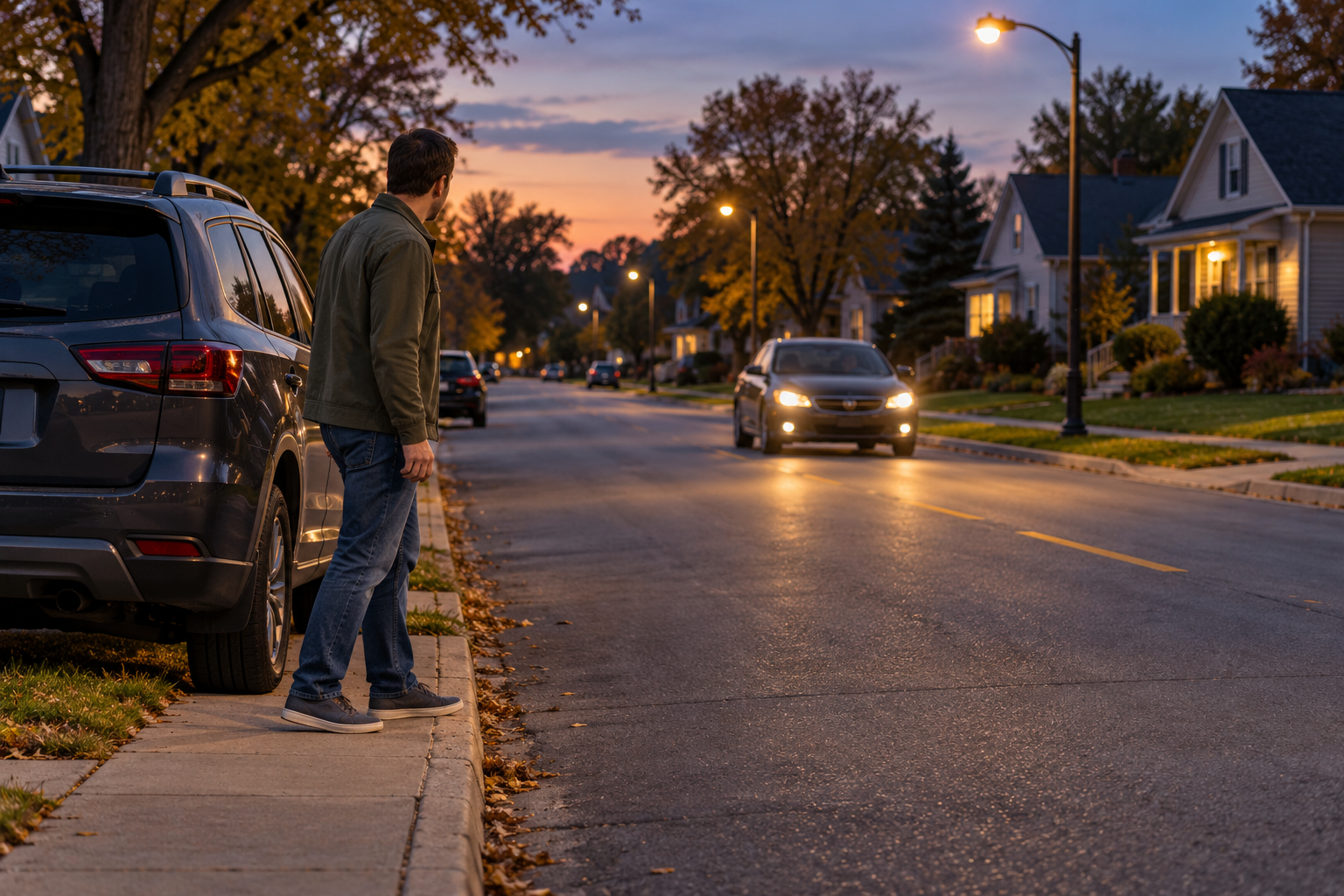
Examine darkness, streetlights, headlights, glare, rain, clothing, parked vehicles, vegetation, and other obstructions. Determine when the pedestrian became visible from the driver’s actual approach. A daylight photograph may reveal little about visibility during a nighttime collision.
Clothing color is one fact to consider. It is not a substitute for examining lighting, lookout, speed, and the available reaction time.
How fast was the vehicle traveling
Speed affects the distance traveled before a driver reacts, the distance needed to stop, and the force of impact. The posted limit is only part of the analysis. Section 321.285 also requires a careful and prudent speed that is reasonable for the conditions.
An investigator should distinguish estimated speed from speed supported by video, vehicle data, or reconstruction. Not every vehicle records every useful fact, and the absence of tire marks does not by itself establish that the driver never braked.
Was either person distracted or impaired
Phone use, alcohol, drugs, fatigue, and diverted attention may affect perception and reaction. These questions should be investigated rather than assumed. Iowa’s electronic-device law, section 321.276, may also apply; the version in effect on the collision date must be checked.
The important issue is how the conduct contributed to what happened. A phone’s presence or a positive test does not, by itself, explain the collision.
Could reasonable care have prevented the impact
Bring the facts together: visibility, speed, distance, pedestrian movement, and the time available to react. Would an attentive driver at an appropriate speed have had time to slow, stop, or give a warning? Did the pedestrian enter so close to the vehicle that avoidance was not reasonably possible?
Some cases require an accident-reconstruction expert. The conclusion should follow the evidence, not a label such as “jaywalking.”
Iowa pedestrian deaths
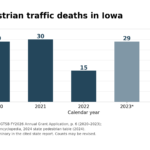 The chart shows 29 deaths in 2020, 30 in 2021, 15 in 2022, 29 in 2023, and 30 in 2024. These are people killed, not the number of crashes, and the statewide totals do not tell us who was at fault in any individual collision.
Data note: The 2020–2023 figures come from page 6 of Iowa’s FY2026 Annual Grant Application; its 2023 figure is labeled preliminary. The 2024 figure comes from NHTSA’s FARS Encyclopedia state pedestrian table. The earlier state report listed 31 preliminary deaths for 2024; the NHTSA table lists 30. Counts can change as records are updated. This chart covers 2020–2024 and does not present a 2025 or 2026 total.
What if both the driver and pedestrian share fault
Iowa Code section 668.3 provides for comparative fault. A claimant’s damages are reduced in proportion to the claimant’s fault. Recovery is barred when the claimant’s percentage exceeds the combined percentage assigned to the defendants, third-party defendants, and released persons covered by the statute.
In a simple case involving only one pedestrian and one driver, a pedestrian assigned 20 percent fault would have damages reduced by 20 percent. At 50 percent fault, recovery is reduced but not barred. At more than 50 percent, recovery is barred.
This is why a crossing violation can matter without automatically defeating a claim.
Preserve the evidence before it disappears

My first concern would be preserving the evidence needed to answer these questions. Nearby businesses, homes, buses, or vehicles may have recorded the collision. Recordings can be overwritten. Vehicles may be repaired or destroyed, and witnesses can become harder to locate.
Important evidence may include original video files, scene photographs and measurements, witness contact information, signal records, vehicle inspections, available electronic data, 911 recordings, and the complete police investigation. Phone evidence may require consent or formal legal process.
A police report is an important starting point, but it should be compared with the underlying evidence. Whether someone received a ticket is not a substitute for investigating civil fault.
If you or a family member has been struck by a vehicle, do not assume that “outside the crosswalk” ends the discussion. Have the crossing location, the applicable law, and the evidence examined together.
At Lombardi Law Firm, the question is not simply who can be blamed. It is what the evidence allows us to prove.
Sources
Iowa Code sections 321.327, 321.328, and 321.329.
Iowa Code sections 321.1, 321.257, 321.285, and 321.276.
Iowa Code section 668.3.
Iowa FY2026 Annual Grant Application, page 6.
NHTSA FARS Encyclopedia — 2024 state pedestrian fatality table.
Editorial note: Statutory discussion checked against the 2026 Iowa Code. For a particular collision, use the law effective on that date.